The Youth Partnership continues to promote and disseminate the findings of its recent studies.
Knowledge Briefs is a series of concise, four-page “focus papers” that provide accessible, user-friendly summaries of key findings, insights, and policy recommendations from recent studies and emerging topics. In 2026, four briefs will be published, building on research conducted in 2024–2025. These will cover topics such as rural youth, democracy and civic space, youth mental health and well-being, climate justice, youth mainstreaming, and more.
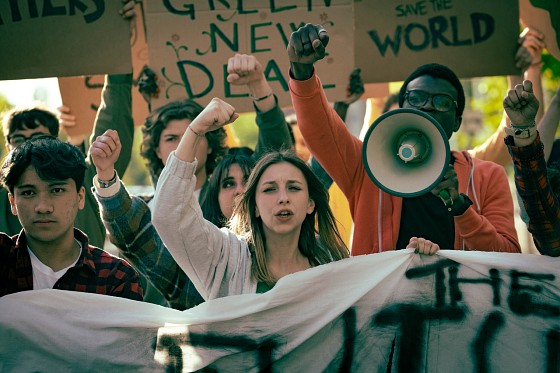
Climate justice in the European youth field
Climate justice is a transformative and intersectional approach to climate action that protects the rights and futures of young people, indigenous people and vulnerable populations. It ensures their meaningful participation in climate decision making, addresses structural inequalities and historical legacies, and promotes equitable relationships between people, communities and the natural world.
The triple planetary crisis is one of the most pressing challenges impacting our societies today and affecting our common prospects for the future (Stapleton and Jece 2024). This is particularly relevant and timely for young people. Not only are they inheriting the consequences of past actions without having contributed to them proportionally, but also they will be most affected by the impacts of this crisis in their lifetimes; and yet they do not have a proportional say/voice/vote to steer decision-making processes. This dual injustice upon the younger generations is widely described as intergenerational injustice, which spans ecological, economic, social and political concerns. Climate justice has been rapidly gaining political, legal and social traction, particularly among young people.
The right to stay in rural areas: an evidence-informed agenda shaped by youth voices?
The European Commission and the Council of Europe have both recently prioritised the need to support rural dwellers’ right to stay and thrive in their communities. This is reflected in the European Commission’s Cohesion and Policy Funds, its EU Youth Strategy 2019-2027 and European Youth Goal 6: Moving Rural Youth Forward. It also follows the Council of Europe Recommendation CM/Rec(2025)3 of the Committee of Ministers to member States on the social, economic and political participation of rural youth.
For rural youth, the “right to stay” is not a legal concept or a political proclamation on mobility choices. It constitutes a policy agenda for enabling younger generations to prosper in the countryside – whether they are locals or newcomers.
This policy brief provides a quick guide for institutional decision makers and organisational leaders from the youth sector and beyond on how to implement a new agenda for rural youth prosperity based on the right to stay. It combines four elements.
A short overview of the policy agenda on the right to stay, driven by the European Union and the Council of Europe.
The discussion of place attachment as a pivotal concept for inspiring policies on the right to stay agenda.
A summary of the evidence upholding the right to stay among rural youth, including a research study on rural youth transitions, published by the EU-Council of Europe Youth Partnership (Youth Partnership 2026).
An overview of the most pressing actionable measures for pushing forward the right to stay agenda among rural youth.