


TO WHOM is it addressed?

In this section you will explore:
- Who the relevant actors are in the youth work ecosystem.
- How to determine who to address with advocacy efforts.
- Which communication strategies to apply when addressing key actors
“They always say time changes things, but you actually have to change them yourself.”
– Andy Warhol
Creating effective advocacy strategies begins with a clear understanding of your target audience. Understanding and mapping out who to address in your advocacy for youth work development and recognition is one of the crucial steps. Effective advocacy strategies are tailored to key actors who have the power to influence and support your advocacy initiative for youth work development and recognition.
These actors are in principle national and local government officials, relevant institutions and policy makers. For some advocacy processes, and as part of advocacy campaigns, you may also need to communicate with and address community leaders, parents and youth (work) organisations, as well as specific professions, such as educators, health workers, social workers, police officers, sports and cultural workers, and celebrities, to build a network of support.
By recognising the various actors involved you can tailor your advocacy efforts to engage each group appropriately, ensuring that your message resonates and inspires action across different sectors and levels of influence.
Download the cards TO WHOM: Target audiences of advocacy for youth work for digital use >>
Download the printable version of the cards TO WHOM: Target audiences of advocacy for youth work >>

Mapping and prioritising relevant actors
Start by listing ALL individuals, groups and stakeholders who have an interest or influence in youth work development and recognition.
These may include:
- Government officials and policy makers: national and local government and parliamentary representatives directly responsible for youth (work) policies, and those from other related sectors. They may include youth officers, ministers and public officials, as well as legislators and members of local and national parliaments.
- Community leaders: influential figures within the community who (might) advocate for youth interests and can mobilise local support.
- Parents and families: key supporters who are directly impacted by youth work initiatives and could mobilise wider support.
- Youth organisations: representative youth associations, youth councils, non-governmental youth organisations, charities and groups involved with young people and dedicated to youth development and empowerment.
- Specific professions with whom youth workers co-operate:
- Educators: teachers, educational consultants & experts, psychologists, school administrators and educational policy makers involved in the formal education of young people.
- Health workers: doctors, nurses, health counsellors and public health officials focusing on youth health and well-being.
- Social workers: professionals who support the social development and welfare of young people who are particularly vulnerable, marginalised and at risk of exclusion.
- Police officers: law enforcement officials who play a role in community safety, youth crime prevention and youth rehabilitation.
- Sport and cultural workers: coaches, trainers, artists and cultural programme co-ordinators who engage youth in extracurricular activities.
- Celebrities and influencers: public figures and social media influencers who can amplify your message and reach a wider audience.
Before moving on, use the Identifier tool (part of this A-Kit) to determine if you are engaging in an advocacy process that has the aim of bringing about concrete policy change!
If you are indeed about to develop an advocacy plan, you can start by narrowing down your initial list of actors to those that are most relevant for envisaged policy change.
These typically include:
- Ministries responsible for youth affairs: typically, a ministry of youth, ministry of education or a combined ministry such as ministry of youth and sports, ministry of social affairs, family and youth. These ministries are in charge of creating and implementing national youth policies, funding programmes and youth-related legislation.
- Parliamentary committees on youth affairs: committees within national parliaments that focus on youth policy, education, employment, social inclusion and other youth-related areas. They play a key role in debating and shaping laws that impact youth work.
- National youth councils: umbrella organisations representing the interests of youth organisations at the national level. They work closely with governments and international bodies to influence youth policy and advocate for youth rights. Also, they are often interested and engaged in processes of recognition and development of youth work.
- Advisory bodies and councils: institutions like national youth advisory councils or youth parliaments that include youth representatives who provide input and advice on policy making. These bodies ensure that young people’s perspectives, in this case in relation to youth work, are considered in governmental decisions.
- Government youth agencies and institutes: specialised public agencies or institutes that support youth policy development, research and programme implementation, such as the National Youth Agency or youth work institutes. They provide expertise, training, research and evaluation of youth work practices.
- Municipal youth offices and regional youth departments within local and regional governments that implement youth policies and provide youth services at the community level. These bodies often work with local youth councils and organisations to address local needs and are closely involved in regulating local youth work.
Also relevant for advocacy for youth work development and recognition are stakeholders at European and international level:
- European Commission (DG EAC), Council of Europe Youth Department, European Youth Forum and other international organisations that influence youth policy at a supranational level, provide funding and set standards for youth work across Europe.
- Youth and youth work-focused NGOs, research institutes and think tanks that engage in advocacy, research and policy recommendations, such as the Alliance of Youth Workers Associations – AYWA, International Youth Work Trainers Guild, the European Youth Information and Counselling Agency – ERYICA and the European Youth Card Association – EYCA. They often collaborate with governmental bodies to shape youth work policy and provide a platform for youth work organisations to influence policy.
How to determine which actor to address
Once you have your wide and detailed list of actors relevant for the youth work development and recognition change that you are advocating for, you are ready for the next step!
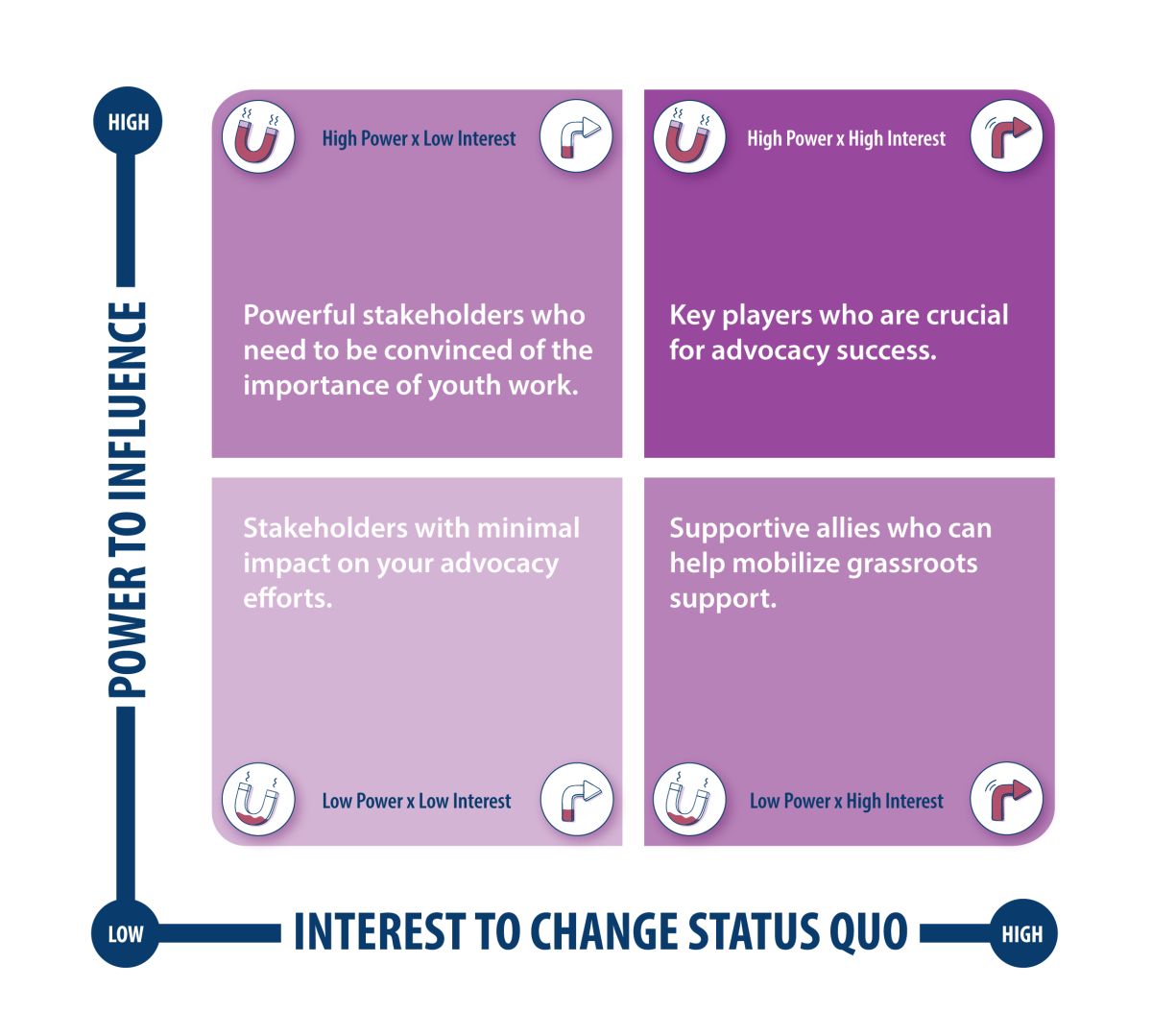
Assess each actor’s level of influence and interest in the change you are aiming for in youth work development and recognition. You can do that by creating a matrix with two axes: Power to influence (low to high) and Interest to change status quo (low to high). Place each stakeholder in the matrix according to their power and interest.
Based on the matrix, prioritise your stakeholders. By systematically mapping and prioritising relevant actors, you can direct your advocacy efforts more efficiently to those in the “High Power, High Interest” quadrant, as they are most likely to support and drive your advocacy initiatives forward.
How to engage with the prioritised actors
Now that you have your prioritised list of actors relevant for the youth work development and recognition change you are advocating for, it’s time for the next step!
Develop tailored communication and advocacy strategies to engage and influence prioritised actors, as well as those actors categorised in other quadrants as they may influence your advocacy efforts.
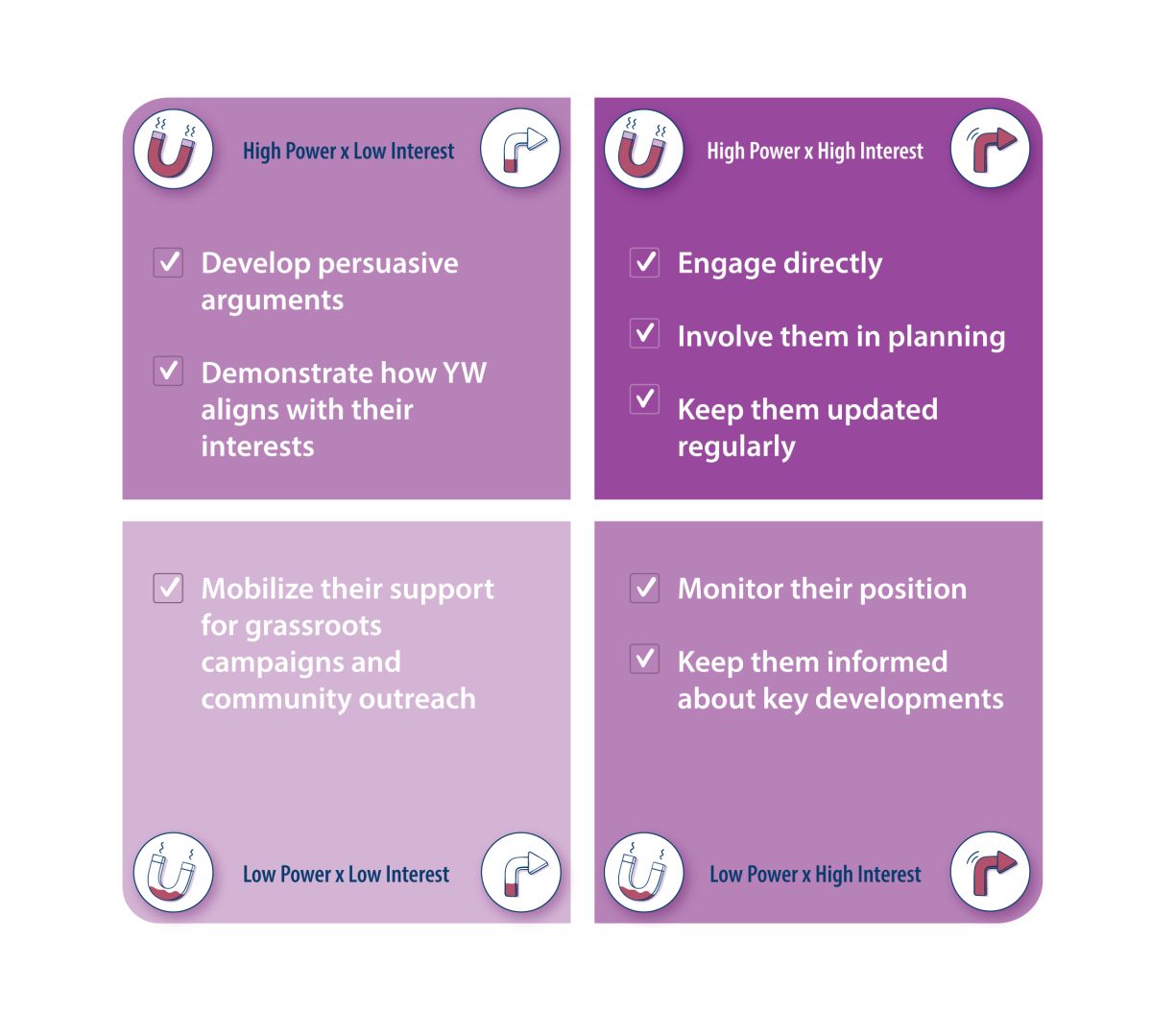
High power / Low interest
- Develop persuasive arguments
- Demonstrate how youth work aligns with their interests
High power / High interest
- Engage directly
- Involve them in planning
- Keep them updated regularly
Low power / Low interest
- Mobilize their support for grassroots campaigns and community outreach
Low power / High interest
- Monitor their position
- Keep them informed about key developments

- Regularly review and update your stakeholder map and engagement strategies.
- Monitor changes in stakeholders’ power to influence and levels of interest to change the status quo, and adjust your approaches accordingly to ensure ongoing relevance and effectiveness in your advocacy efforts.
Developing engagement strategies and tailored communication messages
How to effectively engage prioritised actors
We suggest creating advocacy target personas!
A target persona is a semi-fictional representation of your ideal audience based on real data and research. It includes demographic details, behavioural patterns, motivations and goals. Target personas help you to understand the specific needs and interests of your target audience, concentrate your efforts on the most promising segments and align advocacy efforts with your audience’s needs.
For advocacy for youth work development and recognition, a target persona helps tailor your messages, campaigns and activities to resonate more deeply with the actors you aim to engage and influence. By creating target personas for your advocacy, you can create more relevant and compelling content using the language of the actors you are aiming to influence, addressing their concerns and values more directly, while ensuring your resources are used effectively. In this way you’re more likely to achieve your advocacy goals. The following steps outline how to create a target persona for your advocacy effort.
- Start by collecting data about the priority target audience for your advocacy initiative (e.g. one from the top priority quadrants of the power/interest grid). Use different methods to gather specific information about their age, gender, educational level, occupation, interests and hobbies, challenges and “pain points”, motivations and goals, and of course any relation to youth work either personally or through their children. You could use surveys, interviews, focus groups and social media insights.
- Look for patterns and common traits among your respondents. Group similar characteristics together to form a clearer picture of your audience segments. Based on the common traits identified, create detailed profiles of your target personas. Give them names, and include specific details such as:
- Demographics: age, gender, education, occupation
- Background: personal history, key life events, cultural context
- Goals: what they aim to achieve, both personally and professionally
- Challenges: common obstacles and pain points
- Values and motivations: what drives them, their core beliefs
How to create tailored advocacy messages
We suggest using the personas to inform your advocacy strategies and create specific engagement plans for each prioritised target persona!
Creating tailored advocacy messages involves understanding your target personas in depth and crafting messages that resonate with their specific goals, challenges and motivations. However, firstly, you need to clearly define what you aim to achieve with your advocacy efforts (e.g. policy changes, increased funding, specific youth work-related procedure development). Then you should ensure your objectives align with the interests and priorities of your target personas. Usually, focusing on the most critical messages that address the immediate concerns and goals of your target personas is most effective. However, do develop secondary messages that support and reinforce the primary advocacy points.
When developing and delivering your advocacy message make sure to check out this table:
|
Developing your advocacy message |
Delivering your advocacy message |
|---|---|
| Support your messages with relevant data, case studies and success stories that demonstrate the effectiveness of your proposed solutions. | Choose the most effective format for your messages based on the preferences of your target personas (e.g. detailed reports, executive summaries, infographics, presentations). |
| Provide tangible examples of how similar initiatives have succeeded in other contexts. | Use language that resonates with their professional context and demonstrates a deep understanding of their work. |
| Craft messages that tap into the values and motivations of your target personas. | Highlight how your advocacy efforts align with the target persona’s goals and can help overcome their challenges. Personalise your communication by addressing your target personas by name and referencing specific aspects of their work and achievements. |
| Use emotional and logical appeals to create a sense of urgency and importance around the issues. | Ensure the content is clear, concise, and visually appealing. Use direct communication channels such as emails, letters or face-to-face meetings to convey your messages. |
Furthermore, you may want to test out your messages with a small group of stakeholders to gather feedback and assess effectiveness. Make sure to act upon the received feedback and not stay too attached to your original draft – make adjustments based on the feedback to improve clarity, relevance and impact. As the advocacy campaign is evolving, monitor the responses to your advocacy messages and adjust your strategy as needed. Don’t forget to remain informed about changes in your target personas’ priorities and challenges to keep your messages relevant and timely.
- Ensure your content is relevant, engaging and motivating.
- Test out your messages and integrate received feedback.
- Monitor and adjust to the identified changes.

By tailoring engagement strategies and advocacy messages to the specific goals, challenges and motivations of your target personas for advocacy, you can enhance the effectiveness of your advocacy efforts and build stronger support for youth work development. You can also more effectively support and influence their efforts in youth work development.


- You may imagine different scenarios following the “who – on what – to whom” model, for example:
- Youth work association -> advocating for a systemic solution bringing better career paths and career security for youth workers at local level -> Association of municipalities
- Youth organisation -> advocating for legislative provision ensuring access to youth work for all young people in rural areas -> Parliamentary committee on human rights and inclusion
- Youth workers and youth researchers -> advocating for youth work policy to define quality standards and assign to it adequate funding for implementation at national level -> Ministry of youth
- Municipal youth officer -> advocating for local policy on an increased budget for local youth work outreach -> Mayor